Karpathy's Third AI Paradigm And How Axamy Is Delivering on It
John Honovich

Karpathy wrote something yesterday that I think is really important.
He described three paradigms for how people interact with AI. The first: the LLM is a website you go to. The second: it's an app you download to your computer. The third, and this is where we are now, "is that it is a self-contained, persistent, asynchronous entity with org-wide tools and context, working alongside teams of humans."
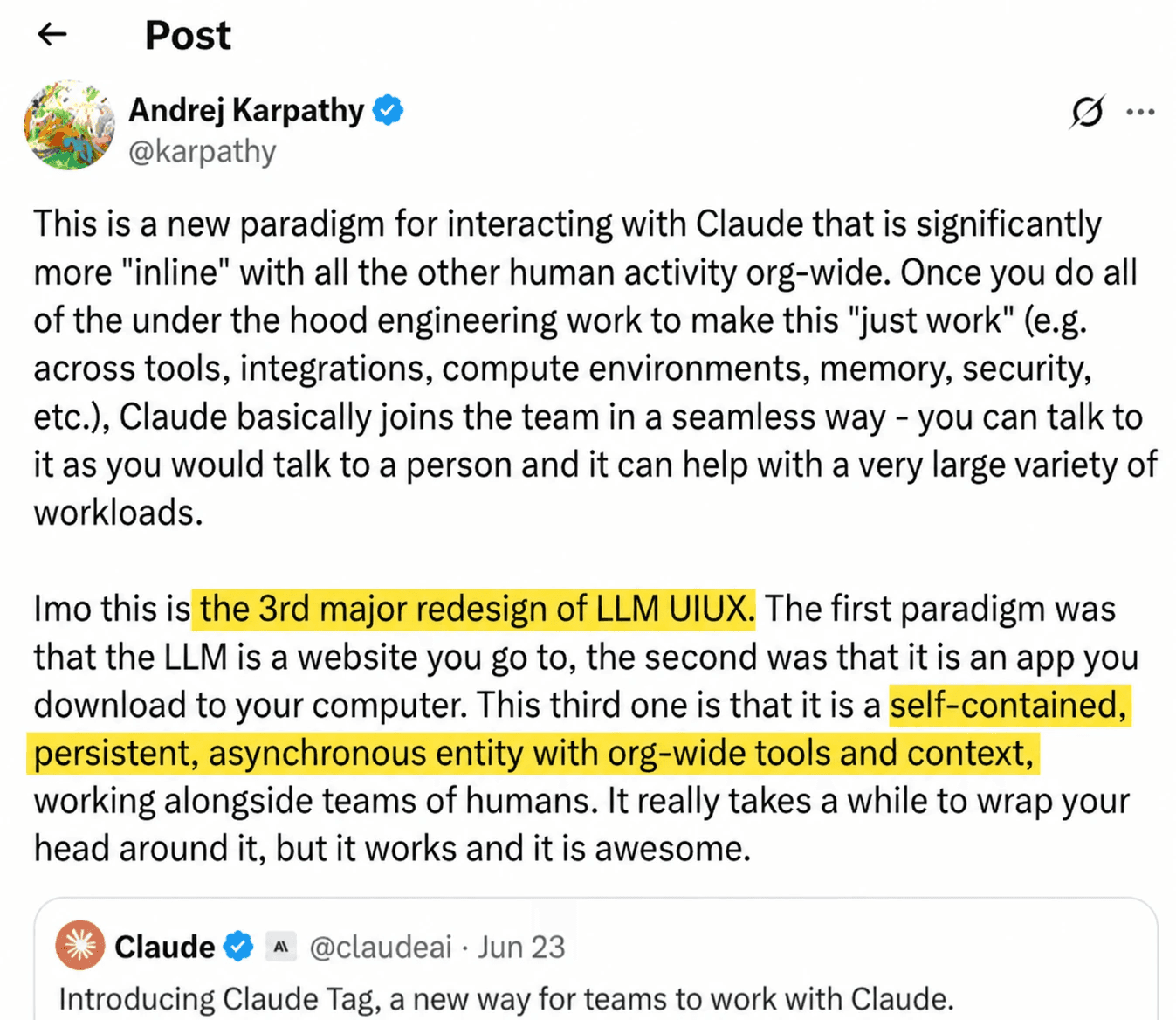
I'd frame it slightly differently. The shift isn't just AI working alongside your team, it's your team working through AI. The AI is the management layer: coordinating work, following up, making sure the right things are happening across the whole org. That's a more active role than a smart colleague in Slack, and it's the role we've been building toward at Axamy for over a year.
Something I talked about with our team this morning: AI is already making individuals dramatically faster. Work that used to take a week now takes a day or two. Work that took a day now takes an hour or two. On our own team, the velocity of software features, reports, analysis, and tests has gone up significantly. And what you see is that when individuals get faster, the coordination burden on the team goes up proportionally. A five-person team that used to manage 10 active things is now managing 30 or 40. The number of decisions, handoffs, feedback loops, and planning touchpoints multiplies along with it.
The issue is that if you're still running the same management processes that worked when you were doing 10 things, you're going to start dropping things at 40. More individual speed without a management layer to coordinate it doesn't fully capture the upside: you get faster individuals, but you don't get a faster organization.
This is the real problem the third paradigm solves. It's not just faster individual work. It's a system that coordinates the team as work moves faster: who's working on what, what's blocked, what feedback needs to get there, what needs to happen next, and how to make sure people are working on the right things across the whole. Work is moving faster, so feedback has to move faster too. Coordination has to move faster. You need a system that keeps up with the velocity you've created.
Everything about Axamy is designed around this. Goals, actions, planning, training, feedback, knowledge management — all of it is built around how teams work together, not just how one person works faster. The preferences, the context, the organizational intelligence — it compounds across the whole team over time, and that's what makes it different from personal AI productivity tools.
Karpathy says it takes a while to wrap your head around the third paradigm. I think the reason is that most people's experience of AI so far has been personal. You've gotten faster, you've found new ways to work. The next step is getting your whole organization faster together, with a system built to make that possible. That's what we're working on.