Microsoft CEO's Viral Tweet, The Learning Loop, And How Axamy Solves This
John Honovich
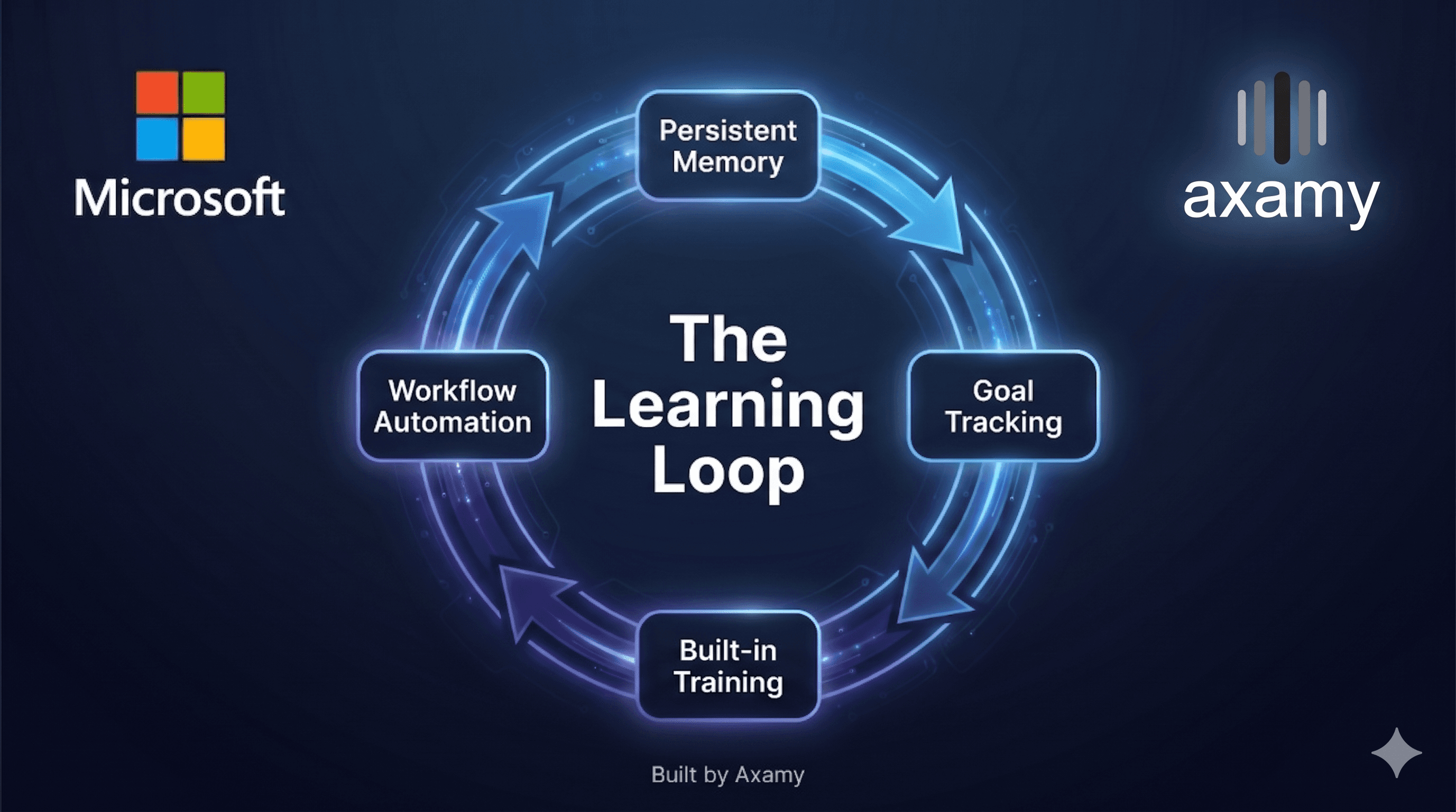
Microsoft's CEO wrote something worth reading this week. The argument: every company needs to build a learning loop where human capital and token capital compound together, and that loop becomes the new IP of the firm. He's right. The part left unanswered is how you actually build it.
Most companies will try to shortcut this. They'll wire an LLM to Slack, add a chatbot to their knowledge base, and call it an AI strategy. What they'll get is his own diagnosis: "compute running in circles." A learning loop isn't something you can prompt-engineer into existence. It requires a real system built underneath it, and that system takes years to get right.
At Axamy, we've spent the last year building exactly what he describes. The architecture has three pieces that have to work together.
Persistent Memory
When a professional services firm using Axamy encodes how their client engagement model works — which partners own which relationships, how deliverables get reviewed, what the escalation path looks like when a project stalls — that knowledge lives in Axamy permanently. Swap out the underlying AI model, and the institutional knowledge stays. This is what the Microsoft CEO means when he says a company should be able to switch out a "generalist" model without losing the "company veteran" expertise.
Goal-Linked Work Tracking
In Axamy, every piece of work connects to an explicit goal with health status, check-in dates, and blockers that surface automatically. A media company using Axamy tracks every assignment across their editorial team — each with an owner, a check-in schedule, and the goal it serves. A marketing agency does the same with client campaigns. When something goes off track, Axamy surfaces it before anyone has to ask. This is what keeps AI from running in circles: continuous awareness of what matters, maintained by the system rather than by individual managers asking the right questions at the right time.
Training Tied to Work
The conventional model is a Learning Management System that sits offline, disconnected from what people are actually doing. In Axamy, training is built into the work itself. A legal team built compliance training tied directly to the workflows their paralegals run — not a generic course catalog, but training that activates when a process gap shows up in actual work. When a domain fluency gap surfaces on a team, tutoring sessions get built and linked directly to the goals they serve. When a behavioral gap shows up in how Axamy itself operates, an action gets created, assigned, and fixed within hours. The system learns from its own failures.
Why This Compounds
What makes this a genuine loop rather than a collection of disconnected features is that these three pieces talk to each other. Memory informs how check-ins are structured. Check-ins inform goal health. Goal health triggers training. Training feeds back into how the system understands the organization. Every improved workflow generates better signal, which is exactly the compounding dynamic the Microsoft CEO is describing.
You cannot vibe-code a learning loop. Building one requires years of decisions about how memory, goals, training, and workflow automation integrate at the system level. The companies that invest in building it properly will have something that compounds. We've been building that system. It works.