For the First Time, You Can Actually Control your Company
John Honovich
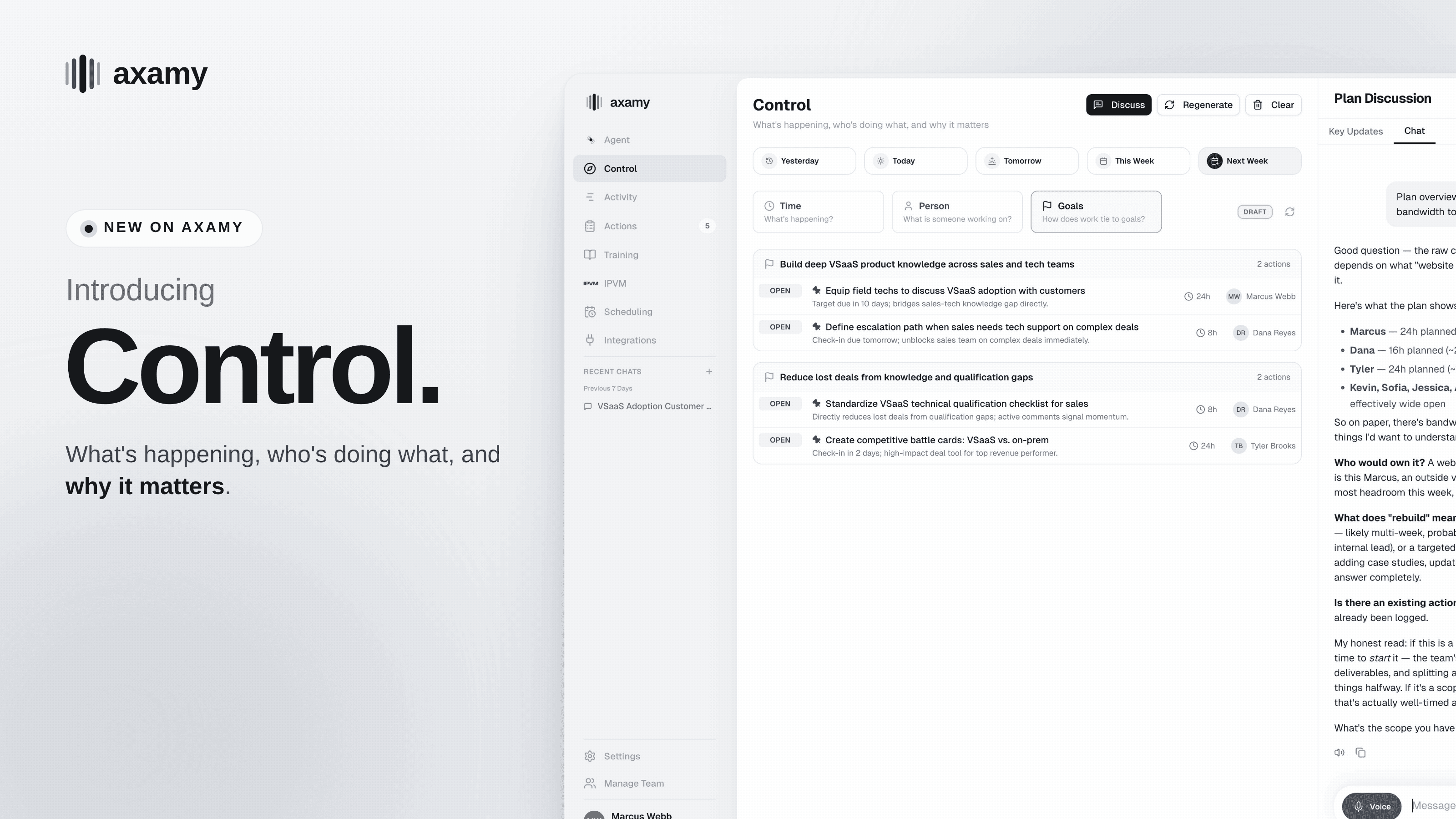
I want to tell you about something that excites me, and after 20 years of running teams, I don't say that lightly.
We just shipped the Axamy Control Panel and planning system. What I think we've built, for the first time anywhere, is a way for leaders and managers to actually control their organizations. Not track things. Not log things. Not look at dashboards. Actually control what's happening, who's doing what, and what happens next.
That's a big claim. Let me explain why I believe it.
The Problem Every Leader Knows
Running a team is a never-ending series of decisions. What should we work on? Who should do it? When? What do we do when something breaks the plan, and something always breaks the plan?
If you've led anything of real consequence, you know this grind intimately. Sports coaches, department heads, startup founders, teachers. It doesn't matter. The coordination tax is brutal, and it compounds.
The frustration isn't just professional. It wears you down personally. Because if you actually care about getting things done, you have to hold the plan in your head constantly. You have to notice when something has gone quiet that shouldn't have. You have to make judgment calls about what to prioritize when three things are all due at the same time.
I've watched good leaders burn out not because the work was too hard, but because the coordination overhead was relentless and there was no relief. The cognitive load of being the person who holds the plan is exhausting in a way that accumulates invisibly, until it doesn't.
Up until now, tools haven't helped much. Project trackers show you what exists. Dashboards show you what happened. Neither tells you what to prioritize, notices when something has gone quiet, drafts tomorrow's plan, or holds the team accountable to it. You still have to read everything, synthesize everything, and make the calls manually, every single day.
What It Actually Feels Like
Last night I used what we built to plan today for our 8-person team across engineering, GTM, and customer work. We discussed the plan together. I changed my mind about a few things, moved work around, pulled some items off, refocused the day around shipping the control panel to production. It updated in real time, flagged three things I hadn't noticed (one person over capacity, one action overdue with no recent update, one dependency I'd missed), drafted an email to the team explaining the day's focus thematically, and sent it.
The whole session took about 20 minutes.
The decisions were still mine. The judgment was still mine. But the cognitive overhead of gathering, synthesizing, tracking, drafting, and communicating was handled. When I wanted to change something, I just said so.
That's not a productivity gain. That's a different experience of what it means to lead a team.
Why a Chatbot Isn't Enough
When people first hear "AI planning system," they imagine a chatbot you can ask questions. That's not what this is.
A chatbot has no memory of your team. It doesn't know that Duc is at 31 hours this week or that the mobile view bug has a firm deadline of Friday. It can't carry work forward from yesterday, notice when something has gone quiet, or adjust a plan dynamically when priorities shift.
It can reason, but it can't manage.
What we've built is a data structure purpose-built for organizational coordination, with AI reasoning layered on top. The two are inseparable. Here's what that means in practice:
Actions and issues with full context: who owns each one, what it's linked to, what's blocking it, and how long it's been open
Capacity modeling: hours per person, current load, over-capacity flags
Dynamic planning: drafts tomorrow's plan, discusses it with you, updates as priorities shift, redistributes work when someone is over capacity
Communication flows: when the plan is set, it drafts and sends the team communication explaining the focus thematically
The key insight is this. Data structures alone only move the information around. The human still has to do all the reasoning. AI alone, without the data structures, has nothing real to reason about. The art is combining them so that the reasoning happens automatically, continuously, and in a way that a human leader can trust and override.
That's what we've spent the last year building.
What We're Building Toward
This is the beginning, not the end. The Control Panel and planning system are the foundation. What we're building on top of it, connecting actions and plans to training and coaching so that what someone is working on and what they're learning are no longer separate tracks, is what turns Axamy from a coordination tool into something closer to a true management system.
I've spent 20 years wishing something like this existed. I used to think the bottleneck was information. If I just had better visibility, I could make better decisions. But the real bottleneck was cognitive load. The information was always there. What was missing was something that could reason about it continuously, draft the plan, discuss it with me, and keep everything moving without me having to hold it all in my head.
That's what we shipped.